
In recent years, matcha has taken center stage in the world of Japanese tea. And there’s no denying that the rich, umami-packed tea is delicious. But no less delicious is matcha’s often-overlooked sister: kukicha.
In my first two months at Obubu, I grew fond of kukicha. Before coming to Obubu, I didn’t know about this tea. My first encounter with kukicha was my second day working at Obubu, and I didn’t realize what it was until later. We were cleaning out the Houjicha factory, at the back of which sat a mountain of large bags of tea, some of which were over fifteen years old. We moved the still-drinkable tea to our sencha factory, and we drove the old tea to a couple of our tea fields to use as fertilizer. We cut open these large bags of aged tea and spread them on the soil between the rows of tea bushes. I was surprised to see that some of this tea resembled little twigs.
Later, I experimented with brewing Obubu’s Suzume Kukicha. I loved the sweet nuttiness and woody notes of the tea. In the following weeks, I learned more details about kukicha beyond its delicious and comforting taste and its use as a fertilizer that made me love the tea more.
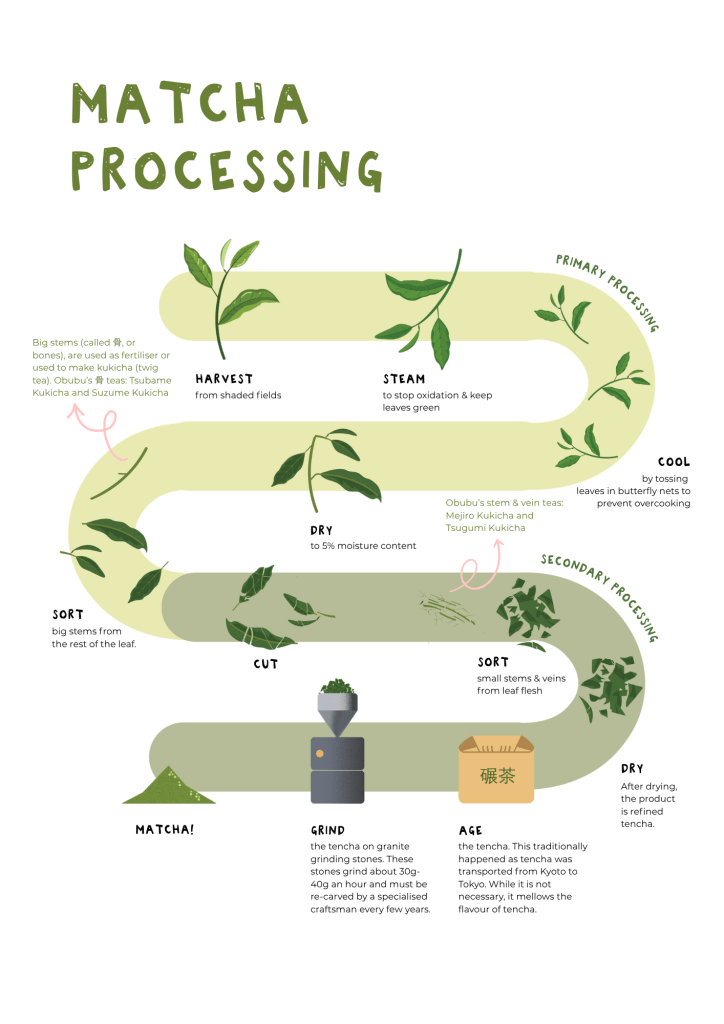
One of these details is that kukicha is often a product of matcha production–when shaded leaves are harvested and processed, the flesh of the leaves is cut up into tencha (which is then ground into matcha), and the stems and veins are sorted out. These stems and veins can be used for kukicha. I find it so fascinating that such different yet delicious teas (tencha, matcha, and kukicha) can be produced from the same leaves.
Another detail that made me fall in love with kukicha is the way the Obubu kukichas are named. On my first farming day in Aoimori, Pau explained to me that the Obubu kukichas are named after birds because the twigs that make up the tea resemble birds’ legs. I enjoyed learning about this detail, and it made me even more fond of this newfound tea. This blog post by a previous intern discusses the birds and flavour notes associated with each of Obubu’s kukichas.
Obubu’s Kukicha
Obubu has four different kinds of kukicha: Tsugumi, Suzume, Mejiro, and Tsubame. Tsugumi and Suzume are both roasted, but Tsugumi is made from the smaller stems and veins of the spring harvest while Suzume is made from the bigger stems of summer harvest. Mejiro and Tsubame, on the other hand are unroasted. Mejiro is made from spring harvest leaves, while Tsubame is made from summer harvest leaves. As a fun fact, each Obubu kukicha has a room in Houjicha House–one of Obubu’s shared houses for interns and assistant managers–named after it.
I love that making kukicha a practice of not wasting and of finding the good and potential in everything.
You can learn how Suzume Kukicha, Tsubame Kukicha, and Tsugumi Kukicha pair with French cheeses on Alix’s (AM #6) cheese and tea pairings blog series!
~ Mia (AM #9)