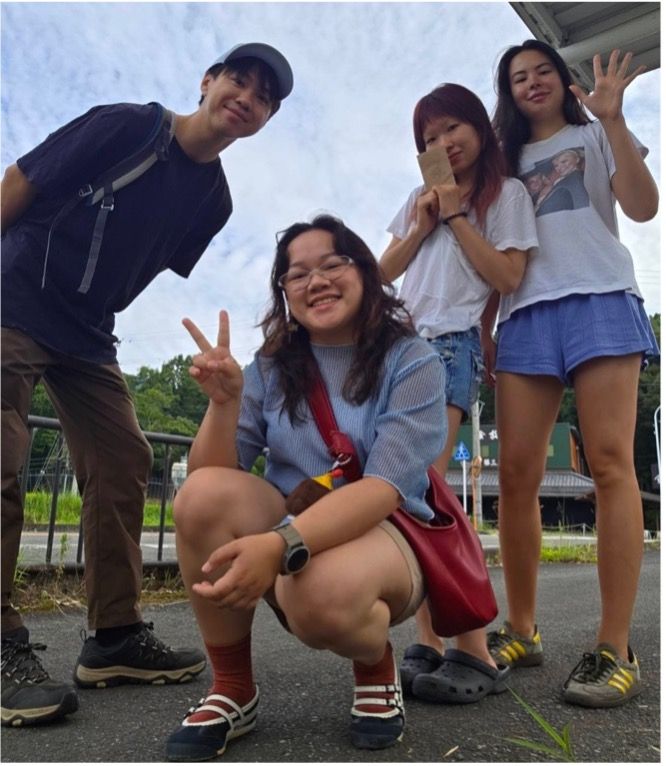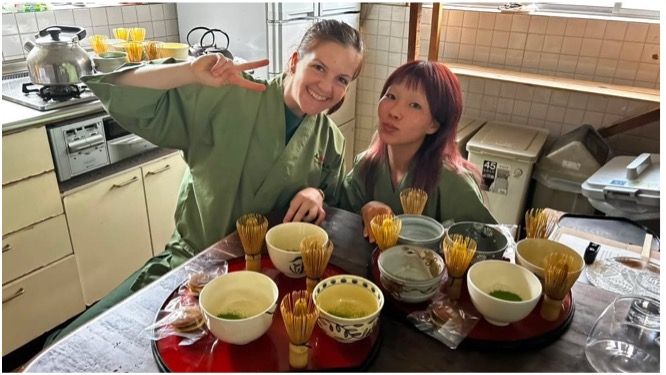
“Let’s enjoy today!”
This is the phrase that everyone at Obubu uses to start the day with a positive feeling.
Hello everyone! My name is Yuna, and I come from Tokyo.
I joined Obubu through a short-term internship program for Japanese participants. Although it was only for five days, Obubu gave me more experiences, encounters, learnings, and precious moments with tea than I could have ever imagined.
In this blog, I would like to share some of the most memorable moments and the things I learned and felt through my life at Obubu.
I hope you enjoy reading it :)
✳︎What Brought Me to Obubu?
First, I would like to share why I became interested in tea and what brought me to Obubu.
I am a 22-year-old university senior, and I joined this short-term internship during my summer vacation. Originally, I wanted to participate during the tea harvesting season, but due to my university schedule, I joined near the end of the harvest period.
There are two main reasons why I became interested in tea.
The first is health. After learning that matcha contains beneficial components such as catechins and theanine, I started drinking it more often. With the growing matcha trend in Tokyo, visiting matcha cafés gradually became one of my hobbies.
The second reason is my memories with my grandmother. When I was in the early years of elementary school, I lived with my grandmother. She loved tea and would prepare tea for me after every meal using a traditional teapot. Even now, whenever I return to my family home, I always look forward to enjoying that moment again.
As I continued to enjoy matcha and Japanese tea, I became interested not only in the taste itself but also in the story behind it. I wanted to understand how tea is grown, how it is produced, and who is involved in creating each cup.
I believed that by learning about its background and experiencing the process myself, I would be able to appreciate each cup of tea even more. This is what motivated me to come to Obubu.
✳︎ The Journey to Obubu
For the first time in my life, I took an overnight bus and traveled about 12 hours from Tokyo to Obubu.
When I arrived at Kyoto Station, it still felt similar to Tokyo because of the busy atmosphere. However, after passing Kizu Station, the scenery gradually changed from buildings to beautiful mountains, and I started to feel that I was truly in Kyoto.
I actually got on the wrong train and arrived one hour later than planned, but now it has become a fun memory.
For me, who had felt a little tired from city life, the nature of Wazuka brought a sense of peace and became a place where I could take a new step forward.
✳︎ Life at Hojicha House
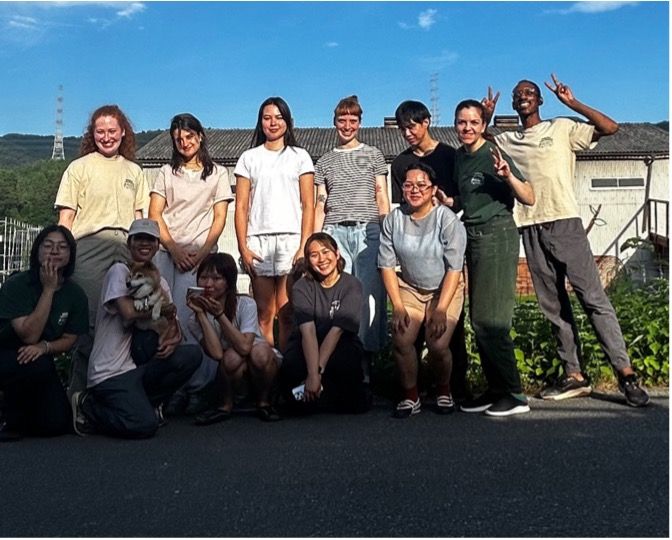
During my five days at Obubu, I stayed at the “Hojicha House.” When I arrived, David DJ showed me around the house, and I was warmly welcomed by the unique and wonderful members. There was Chongjung, who can play the cello and is like a walking tea encyclopedia; LeeSong, who has amazing musical talent and is loved by everyone; David (No.2), who loves Chiikawa (aJapanese character) and became “Kevin” for one day because I accidentally called him by the wrong name; Monica, whose cute smile always brightened the room and who only makes delicious food; and Donovan, who I shared many meals with during my five days and who was always thoughtful and caring.
I will never forget the view of the tea fields shining in the morning sunlight from my bedroom window, or the support and kindness I received from everyone at Hojicha House throughout my stay.
✳︎ Memorable Experiences
・Farming
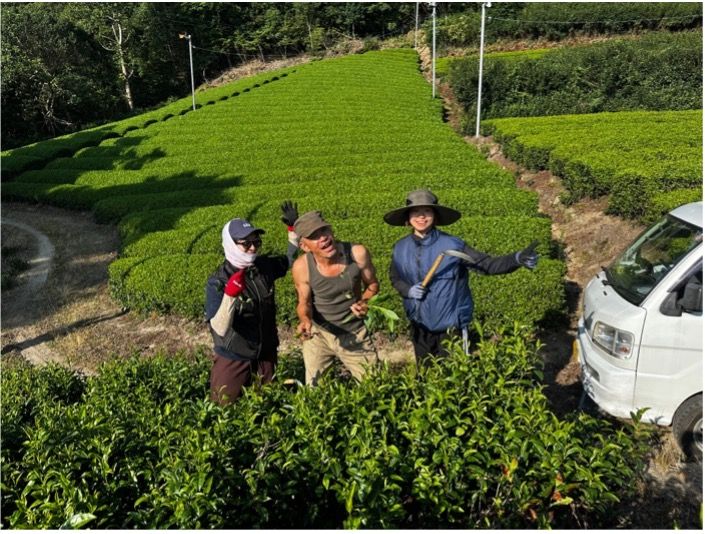
I had the opportunity to visit the tea fields on the first day and the morning of my fourth day.
On the fourth day, we gathered at 7:00 a.m. and traveled to the tea fields by truck. As a small side note, riding in the back of a truck had actually been a childhood dream of mine, so Obubu made that dream come true(笑).
At the tea fields, I worked with Monica and Maren under Akki’s guidance, helping with tasks such as removing weeds and maintaining the tea plants.
This experience allowed me to apply what I had learned about agriculture through the JTB program. More importantly, I was able to see and feel firsthand how Japanese tea is grown and produced before reaching our cups. It was a truly valuable experience and one of the main reasons I wanted to come to Obubu.
・Presentation
On the afternoon of the second day, I gave a presentation about why I came to Obubu, why I became interested in tea, and what I wanted to learn from this experience.
Since the entire presentation was in English, I felt nervous and worried about whether I could express myself well. However, thanks to the warm support from the Obubu staff and other interns, I was able to complete it successfully.
Preparing for the presentation before coming to Obubu helped me organize my thoughts, and I was especially happy that I could share my feelings and experiences with everyone.
・JTB
Through the JTB program, I learned about three main topics: tea production processes, tea components, and agriculture.
In the first class, I learned about how Japanese tea is produced and the characteristics of different types of tea. I was especially fascinated by how processes such as steaming, rolling, and drying create the unique flavors, aromas, and shapes of tea leaves.
I also learned that matcha is not simply powdered tea leaves. The tea plants are shaded for a certain period before harvest, processed into tencha, and then carefully ground into fine powder. Understanding the effort and techniques behind matcha made me appreciate it even more.
In the class about tea components, I learned about catechins, theanine, and caffeine, and how each component affects our bodies and the taste of tea. I found it especially interesting that theanine changes into catechins through exposure to sunlight, which helped me understand why cultivation methods influence the flavor and characteristics of tea.
I also learned that although tea has many health benefits, it is important to understand its properties and enjoy it in moderation.
In the agriculture class, I learned that choosing tea varieties and managing tea plants involves many considerations, including yield, quality, climate adaptation, and resistance to diseases.
I realized that the tea we casually drink every day is supported by scientific knowledge, advanced cultivation techniques, and the continuous efforts of tea farmers.
✳︎ What Obubu Taught Me?
Through my five days at Obubu, my perspective on Japanese tea changed completely.
Before coming to Obubu, like many young people in Japan, I mainly enjoyed matcha because it was healthy and popular. However, my experience at Obubu taught me that the value of Japanese tea goes far beyond those aspects.
Each tea leaf has its own characteristics depending on the variety and region where it is grown. Behind every cup of tea are the efforts of farmers, generations of knowledge and techniques, as well as the culture and history of Japanese tea.
I learned that there are many stories and emotions behind something we often enjoy without thinking deeply about.
I also realized how important the people who connect tea farmers and consumers are. Selling tea is not the only role they have; sharing the culture, history, and passion behind tea allows people to understand and appreciate its true value.
One phrase that especially stayed with me during this internship was something Hiro-san said:
“Matcha became successful not as a beverage, but as a flavor.”
And this made me think deeply about something.
It is easy to follow a trend, but it is not easy to preserve and pass down tradition.
I believe the current matcha boom is a wonderful opportunity for more people to discover Japanese tea. However, I would feel that it is a missed opportunity if people’s interest stopped only at matcha.
I hope that matcha can become a gateway for people to explore other types of Japanese tea, such as sencha, gyokuro, and hojicha, as well as the farmers who dedicate their lives to producing them.
By helping more people discover the culture, history, and stories behind Japanese tea, I hope its beauty will continue to be passed on to future generations.
For me, my five days at Obubu were not only a time to learn about tea, but also a special experience that completely changed the way I see Japanese tea.
The time I spent in Wazuka was wazuka (a Japanese pun: Wazuka sounds almost the same as wazuka,meaning “just a little” or “only a short time”). Yet that little time was filled with the beauty of tea and unforgettable memories.
Thank you, Obubu.
Thank you, Wazuka.
And thank you to everyone who was part of this incredible experience.